
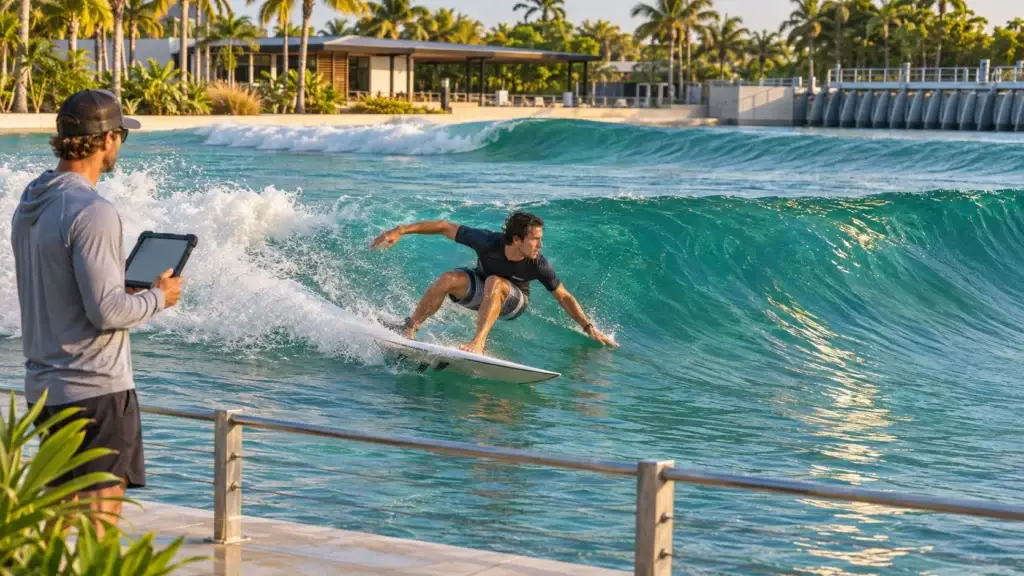
If you’re wondering how to improve your surfing faster, the answer is better repetition. You need enough quality waves to try a move, notice what went wrong, change one thing, and try again while the feeling is still fresh.
That’s hard in the ocean. Part of every session goes to paddling, sitting through lulls, repositioning, and competing for waves that are never quite the same twice.
Consistent waves change that. At The Point Surf Park, our controlled sessions give you a repeatable wave, so you can focus on one part of your surfing instead of adapting to a new shape every time. If you already catch unbroken waves, angle down the line and trim, that consistency turns a normal surf into deliberate practice.
Why Do Consistent Waves Help You Improve Faster?
Consistent waves remove many of the variables that make ocean practice unpredictable. When the wave shape is controlled, you can repeat the same skill and compare one attempt with the next. If you’re curious how that’s possible, it comes down to how a surf wave pool works.
It doesn’t make surfing easy. Timing, positioning, balance, speed, and decision-making still matter. What changes is your ability to isolate a mistake.
If your bottom turn was too shallow, you can get lower and hold the line longer on the next wave. If your top turn was late, you can start setting it up earlier, instead of waiting twenty minutes for a similar section.
Same Wave, Same Section, One Skill at a Time
Repetition matters most once you’re past the beginner stage. Most intermediate surfers know what a good bottom turn or cutback looks like. The gap isn’t understanding the move; it’s getting enough good attempts to make it automatic.
A controlled wave lets you work on details like:
- Where you look before a turn
- How low you compress
- When you shift your weight
- Where you place the board on the face
- When you extend out of the turn
- How you carry speed into the next section
Trying to fix all of those at once rarely works. Pick one.
Less Waiting Means More Focused Practice
In the ocean, downtime is part of the experience. But if your goal is training, long gaps between similar waves make it hard to repeat a move while the last attempt is still fresh.
Our sessions run on a one-surfer-at-a-time priority queue. If you miss your wave, fall, or end up out of position, you go back to the queue for your next turn. It still takes patience and fitness, but the waves arrive on a set rhythm instead of depending on the swell.
Wave counts are never guaranteed. In one example reported by WavePoolMag, an experienced surfer caught 31 waves in an unusually quiet one-hour session at another surf park, against his usual 20 to 25. Your own count depends on the session format, crowd size, your ability, missed waves, and operating conditions.
How Should You Plan a Progression Session?
Go into the water with one main goal. “Surf better” is hard to measure; a specific target gives every wave a purpose. Pick something narrow:
- Stronger bottom turns
- Cleaner top turns
- Better cutbacks
- More speed through flat sections
- Earlier positioning
- Smoother links between maneuvers
You can still surf naturally. The goal just gives you one detail to come back to after each wave.
Pick One Skill Per Session
Say you’re working on bottom turns. Your first wave is your baseline. Did you start the turn too early? Stand too upright? Look down instead of at the section you wanted to reach?
Choose one fix for the next attempt. That gives you a simple cycle: surf, review, adjust, repeat. It’s the biggest advantage of training in a wave pool, because you don’t have to wait for the ocean to hand you another similar setup.
Set a Target Number of Quality Attempts
You don’t need a guaranteed wave count to train with purpose. Set an attempt goal inside whatever waves your session gives you. For example, spend your first five suitable waves getting lower through the bottom turn, then shift to where the turn releases.
Quality beats quantity. Ten focused attempts where you change one thing can teach you more than twenty waves with no plan.
Keep the goal realistic for your level. If you’re still working on reliable trim and positioning, there’s little value in forcing advanced maneuvers before the foundation is solid.
Should You Film Your Waves?
Video is one of the fastest ways to see the gap between what a move feels like and what actually happened. A turn can feel powerful from the board while the footage shows you lost speed before the section. You might think you’re compressed, then see your legs stayed almost straight.
When you review footage, watch only for the skill you chose before the session. If you were practicing top turns, look at your approach angle, body position, timing, and where the board redirects. Leave everything else for another day.
GoPro and Insta360 cameras are welcome only in approved mounts and in sessions where we allow them, and drones aren’t permitted on our property. Check the rules for your session before you bring a camera into the water.
How Does Feedback Speed Up Your Progress?
Feedback speeds things up when it points you at the right thing to change. Without it, you can repeat the same mistake for twenty waves because you’re focused on the wrong part of the maneuver.
That feedback can come from video, a surf buddy watching from the side, or a coach. The common thread is one clear observation per session, turned into one change on your next wave.
How Often Should You Surf to See Progress?
Regular sessions beat cramming everything into one exhausting day. Long gaps mean you spend each session rebuilding timing and paddle fitness before you can work on technique again.
There’s no perfect number of sessions per week. Your schedule, fitness, recovery, goals and level all play a part. A better question is whether you come back often enough to remember what you learned last time.
A few quick notes after each surf help:
- What worked?
- What kept going wrong?
- Which single skill should you train next?
- Did fatigue change the second half of your session?
Those notes turn separate sessions into one connected training plan.
What Should You Train Out of the Water?
Surfing improves fastest when your body can do what your technique asks. You don’t need a complicated program, but three areas carry over well.
Paddle Fitness
Better paddle fitness helps you recover between waves and get back into position without arriving exhausted. Swimming, upper-body endurance work and surf-specific paddling all help; match the training to your ability and health. Fatigue changes technique, and a surfer who turns well when fresh often stands taller and reacts later once tired.
Mobility
Hip, ankle, upper-back and shoulder mobility affect how freely you move on the board. You don’t need extreme flexibility, just enough usable range to compress, rotate, reach and recover without feeling restricted.
Pop-Up Drills
Intermediate surfers still benefit from pop-up practice. On faster waves, a slow or uneven pop-up puts you behind before the ride begins. Practice clean movement rather than speed, and aim to land in a stance you can surf from immediately.
Do Wave Pool Skills Carry Over to the Ocean?
Most technical skills do. Turns, speed generation, stance, timing, board control and balance are surfing skills wherever the wave comes from.
The ocean adds its own demands: reading swell, currents, shifting peaks, wind, tides and other surfers. Controlled waves sharpen your technique, while ocean sessions build broader judgment. The two work best together, and there are real differences between surf park and ocean surfing worth knowing before you switch between them.
When Should You Move Up a Level?
Move up when your current level feels controlled and repeatable, not because you landed one great wave. We base advancement on comfort, control, consistency, wave reading and overall ability, and after several sessions you can ask us for an assessment.
Higher levels bring more speed, power and intensity. If you still miss takeoffs, lose the open face, or struggle to control your board where you are, a faster wave won’t fix it. Make the skills automatic at your current level first, then compare our surf levels to see what comes next.
Frequently Asked Questions
How Many Waves Will I Catch in a Session?
There’s no guaranteed count. It depends on the session format, the number of surfers, whether you make your turn in the queue, missed waves, and operating conditions. Focus on making each wave useful rather than chasing a total.
What Should an Intermediate Surfer Work On First?
Start with the bottom turn. It sets up almost every other maneuver, and a stronger one gives you more speed and better position for everything that follows.
Is One Long Session Better Than Two Short Ones?
Not always. Two focused sessions, with time to recover and review in between, often teach more than one long session where fatigue breaks down your technique. The best choice depends on your fitness, goals, and the session formats available.
Can I Bring a GoPro to Film My Waves?
Possibly. We allow GoPro and Insta360 cameras only in approved setups and in sessions where they’re permitted. Check the rules for your session first, and remember that drones aren’t allowed.
Final Thoughts
Improving faster isn’t just about surfing more waves. It’s about making more of your waves useful.
Choose one skill. Repeat it on consistent waves. Review what happened, change one thing, and try again, then come back before the lesson fades. That’s how surfing turns from random repetition into deliberate practice.
The ocean will always teach adaptability, judgment, patience, and wave reading. Controlled waves give you something different: a place to isolate technique and repeat it with fewer variables. Use both, and your progress becomes far more intentional. You can also read what other surfers say about us on Google.
Put Your Reps In at The Point
You don’t need a harder wave to improve faster. Start with the session that matches your current ability, pick one skill, and use the consistency to build cleaner, more repeatable surfing.
Build the reps first, then move up when your surfing shows you’re ready. Have questions before your first session? Plan your visit, and we’ll help you get set.