
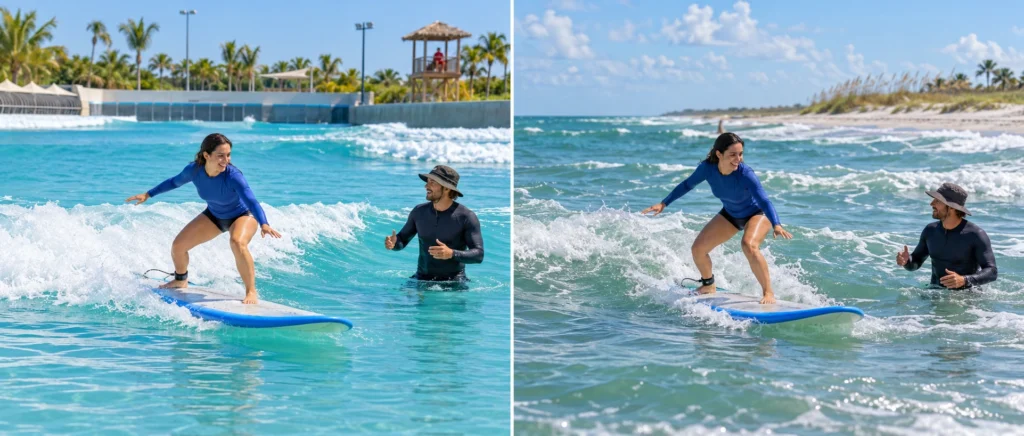
When you are learning to surf, one of the first questions is where you should start. Do you head straight to the beach and learn in natural waves, or begin somewhere with controlled conditions? The Surf Park vs. Ocean Surfing experience can feel very different for a first-time surfer. Ocean surfing introduces you to natural waves, currents, changing conditions, and the rhythm of the coastline. A surf park gives you more predictable waves and a structured environment where you can concentrate on basic skills. At The Point Surf Park, we believe both experiences have value. Our surf park Fellsmere environment gives beginners another way to enter the sport without needing the ocean forecast to cooperate. The goal is not to replace the ocean. It is to give new surfers a controlled place to practice the basics before adding more variables.
Is a Surf Park or the Ocean Better for Beginner Surfers?
For many beginners, a surf park can provide an easier environment for learning the basic mechanics of surfing because the waves are controlled and more predictable. A new surfer can focus on body position, paddling, standing up, balance, and board control without also trying to understand changing tides, currents, wind, and natural wave patterns. At The Point Surf Park in Fellsmere, beginner sessions use controlled waves, soft-top boards, helmets, pre-session briefings, and skill-based progression. Ocean surfing provides a different and equally important experience because surfers must learn how to identify suitable waves, understand changing conditions, manage currents, position themselves in a natural lineup, and respond to other ocean hazards. NOAA specifically recommends that beachgoers understand rip-current risks, check local surf conditions, and use lifeguard-protected beaches whenever possible. For complete beginners, a surf park can provide a structured starting point, while ocean surfing introduces the environmental awareness needed to become a more complete surfer.
How Are the Waves Different?
The biggest difference is consistency. In the ocean, every wave is shaped by natural forces. Wind, swell direction, tide, water depth, sandbars, and coastal features can affect how a wave approaches and breaks. You may catch one smooth beginner-friendly wave and then wait several minutes before another suitable one appears. A surf park removes much of that unpredictability. Controlled wave technology allows waves to be produced according to a planned session. Beginners can receive waves designed for learning rather than depending on whatever conditions happen to arrive at the beach. That repetition makes it easier to recognize mistakes. If the wave is relatively consistent, you can pay more attention to whether your feet were positioned correctly, whether you stood too early, or whether your weight was too far forward.
Do You Have to Paddle as Much in a Surf Park?
Paddling is still part of surfing, but the overall experience can be different. In the ocean, surfers often paddle through breaking waves, move along the lineup, adjust to currents, and reposition themselves repeatedly. That can be physically demanding for a new surfer. A controlled session reduces some of those variables because the surfing area and wave delivery are organized. Beginners can spend more attention on the specific paddling needed to catch and ride a wave rather than constantly trying to stay in the correct part of a changing ocean lineup. However, learning to paddle effectively is still important. If you eventually want to surf in the ocean, paddling endurance and positioning will become increasingly important parts of your progression.
Is a Surf Park Safer Than Ocean Surfing?
A surf park removes some ocean-specific hazards, but surfing is never completely risk-free. Natural beaches can have rip currents, shorebreak, changing weather, underwater features, tides, and waves that vary significantly during a session. NOAA describes rip currents as powerful channels of water flowing away from shore and notes that they account for more than 80 percent of rescues performed by surf-beach lifeguards. NOAA advises checking surf-zone forecasts, knowing how to swim, following lifeguard instructions, and using guarded beaches whenever possible. A controlled surf environment does not have the same natural coastal conditions. At The Point, current visitor guidance includes skill-based bookings, pre-session briefings, soft-top boards for beginner sessions, and mandatory helmets for beginner lessons and sessions. Surfers can still fall, collide with a board, or make mistakes, so safety instructions remain important.
What Is Different About Learning to Read Waves?
This is one area where ocean surfing offers a skill that a controlled wave environment cannot fully reproduce. In a surf park, you know a wave is coming. In the ocean, you first need to identify it. Surfers learn to watch the horizon, recognize approaching sets, judge where waves may break, and reposition themselves. That skill takes time. Beginners often paddle for waves that do not break, miss waves because they are too far outside, or find themselves too close to where the wave is already breaking. These are normal parts of ocean progression. A surf park lets you develop board skills first. When you later enter natural surf, you can concentrate more on understanding the ocean because some of the physical surfing movements already feel familiar.
Is It Easier to Stand Up in a Surf Park?
It can be easier to practice the movement consistently. Standing on a surfboard requires several actions to happen quickly. You need the right position on the board, enough forward movement, proper timing, a controlled pop-up, balanced foot placement, and awareness of where the board is going. A predictable wave gives you more opportunities to repeat that sequence under similar conditions. That does not guarantee you will stand immediately. Some people stand during their first session. Others need several sessions. The benefit is repetition. A beginner can try, receive feedback, make one adjustment, and try again without waiting for the ocean to produce another similar wave.
What Do Beginners Learn at The Point Surf Park?
The Point is designed around progressive surfing rather than putting everyone into the same waves. Our Plan Your Visit guide explains that visitors should book the session level that matches their ability, arrive early for check-in and gear, and complete a pre-session briefing. Beginners can use soft-top boards, and helmets are required for Beginner surf lessons and Beginner sessions. Rental equipment is also planned on site. At the surf park in Fellsmere, the goal for a first-time surfer is not advanced performance. It is building comfort with the board, learning basic positioning and timing, practicing standing, and understanding how your movements affect the ride. From there, surfers can gradually progress toward more challenging sessions.
What Does the Ocean Teach That a Surf Park Does Not?
Ocean surfing requires environmental awareness. You need to learn how conditions change, how currents affect your position, where waves are breaking, and how other surfers move through a natural lineup. You also need to understand beach-specific hazards. For example, nearby Sebastian Inlet is a well-known Florida surf destination. Florida State Parks describes more than three miles of Atlantic beach there and identifies First Peak as one of Florida’s most consistent surf breaks. Those natural conditions can provide an incredible surfing experience, but beginners need to choose locations and days that match their abilities. Learning ocean safety should therefore be part of progressing from controlled waves into natural surf.
Can Skills From a Surf Park Transfer to the Ocean?
Yes, many of the physical skills transfer directly.
These include:
- Body position on the board
- Paddling technique
- Pop-up mechanics
- Foot placement
- Balance
- Looking in the direction you want to travel
- Basic turning
- Board control
- Recovering after a fall
What does not automatically transfer is ocean knowledge. A surfer who becomes comfortable riding controlled waves still needs to learn currents, wave selection, lineup etiquette, paddling through surf, changing weather, and local conditions. That is why the two environments can complement each other. One can help develop repeatable technique while the other teaches adaptability.
Is a Surf Park Good for Nervous Beginners?
It can be. Many first-time surfers are not mainly afraid of standing on a board. They are nervous about everything happening around them. They may worry about strong waves, being pulled away from shore, getting in another surfer’s way, or not knowing where to position themselves. A structured environment removes several of those unknowns. You know what session you booked, what equipment you will use, and that the waves are designed for a particular skill category. For some beginners, that structure makes the first experience feel more approachable. Confidence matters because a nervous surfer often becomes tense, and tension can make balance and movement harder.
Do You Still Need Ocean Safety Knowledge After Learning in a Wave Pool?
Yes. Anyone who plans to surf in the ocean should learn ocean-specific safety. NOAA recommends knowing how to swim, checking the surf forecast before entering the water, using lifeguard-protected beaches where possible, and never swimming alone. Understanding rip currents is particularly important. If caught in one, NOAA advises against trying to swim directly against the current. Instead, stay calm, conserve energy, and move out of the current according to current official safety guidance. Learning controlled-wave surfing and learning ocean safety are separate parts of becoming a capable surfer. Do not assume success in one environment means every natural surf condition is appropriate for your ability.
Should You Start at a Surf Park Before Surfing in the Ocean?
You do not have to. Many surfers have successfully learned in the ocean for generations. A surf park simply gives beginners another route. Someone who has access to safe beginner ocean conditions, appropriate instruction, and experienced supervision may enjoy starting at the beach. Someone who feels nervous about the ocean or wants more repeatable practice may prefer beginning with controlled waves. The right starting point depends on your comfort, water ability, access to instruction, and goals. What matters most is choosing conditions that fit your current experience.
Why Start Your Surfing Journey at The Point?
At The Point Surf Park, we want surfing to feel approachable whether someone has years of experience or has never touched a surfboard. Our Fellsmere location is designed around controlled waves, progressive skill levels, instruction, equipment access, safety briefings, and a family-friendly environment. We also sit about 20 minutes from Florida’s coast, giving visitors the opportunity to enjoy both the surf park experience and the broader Treasure Coast. That combination is what makes the Surf Park Fellsmere experience useful for beginners. You can develop basic surfing skills in a structured environment while still being close to the natural coastline that makes Florida surfing special. We see the surf park and the ocean as two different experiences that can help surfers grow in different ways.
Frequently Asked Questions
Will Learning in a Surf Park Make Me Ready for the Ocean?
It can prepare you with useful physical skills, but you still need to learn ocean safety, currents, wave selection, lineup awareness, and changing conditions before surfing independently at natural beaches.
Is Ocean Surfing Better Than Wave Pool Surfing?
Neither is universally better. They provide different experiences. Wave pools offer consistency and repetition, while ocean surfing develops adaptability and understanding of natural surf conditions.
Do Beginners Need Their Own Surfboard at The Point?
No. The Point plans to offer rental equipment, including soft-top boards for learning. Current rules require soft-top surfboards for all Beginner sessions.
Can I Surf at The Point and Sebastian Inlet on the Same Trip?
The areas are close enough to make both part of a Treasure Coast visit, but whether you should surf the ocean depends on your ability and current conditions. Florida State Parks identifies Sebastian Inlet as a notable East Coast surf destination, but beginners should choose natural conditions carefully and follow local safety guidance.
Final Thoughts
The biggest difference in Surf Park vs. Ocean Surfing for beginners is predictability. A surf park lets you concentrate on surfing movements while the waves and session structure are more controlled. The ocean requires those same surfing skills plus the ability to understand constantly changing natural conditions. Neither environment needs to replace the other. Controlled waves can help you practice. The ocean can teach you how to adapt. For many new surfers, starting in a structured environment and gradually adding ocean experience can make the learning process feel less overwhelming. What matters is progressing at a pace that matches your skill, water confidence, and understanding of safety.
Build Your Basics Before Chasing the Next Wave
If you want to experience surfing in a more structured setting, explore The Point Surf Park in Fellsmere. Before your visit, review our Plan Your Visit guide for session levels, equipment, rentals, arrival information, and current beginner requirements.