
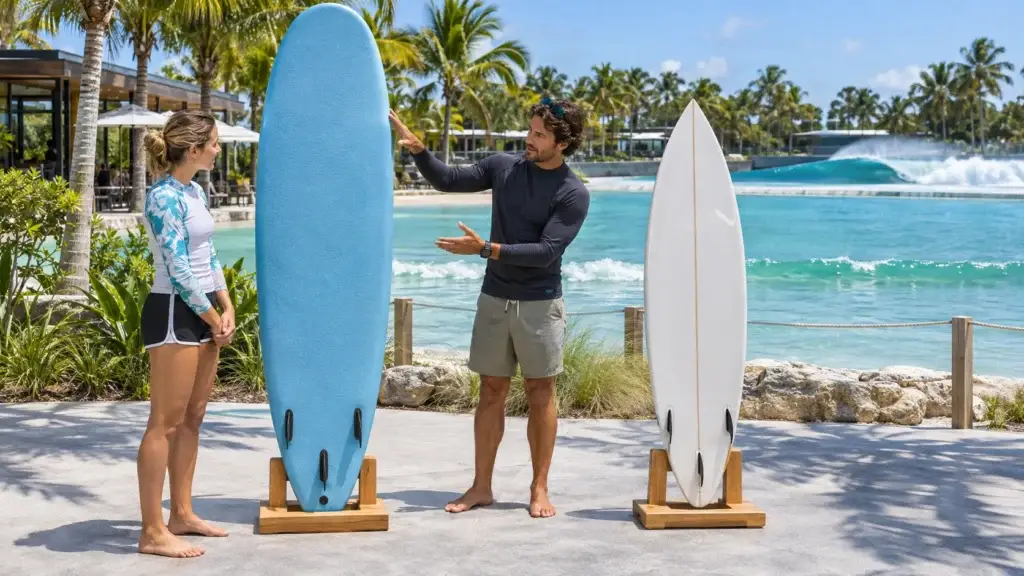
The wrong board makes surfing much harder than it needs to be. Beginners usually progress faster on a longer, wider, higher-volume soft-top that paddles easily and feels stable. Experienced surfers move toward lower-volume hard-tops that turn faster and respond more directly.
Choosing between a beginner and a performance surfboard isn’t about riding the smallest board you can handle. It’s about having enough stability to catch waves consistently while matching the kind of surfing you’re ready for.
At The Point Surf Park, the choice also depends on the session you book. Beginner sessions require soft-tops, and hard-tops open up as your skills and session level progress.
What Makes a Surfboard Beginner-Friendly?
A beginner-friendly board makes paddling, catching waves, standing up and staying balanced easier. That usually means more length, more width, more volume and a forgiving shape.
At this stage, turning performance isn’t the goal. Stability and paddle power are, because they let you repeat the fundamentals. A board that’s too small slows you down: you spend more time fighting to catch waves and keep your balance than actually practicing.
Length, Width and Volume
Longer, wider boards give you more surface area and stability. Volume is the space inside the board, usually measured in liters. More volume means more buoyancy, which lifts you higher in the water, makes paddling easier, and helps the board get into waves with less effort.
Volume works together with your weight, ability, the wave, and the board’s shape. evo’s guide to choosing a surfboard explains how rocker, nose and tail shape change the way a board paddles and turns.
As a beginner, you don’t need to chase an exact liter number from an online chart. You need enough board under you to paddle comfortably, catch waves consistently and stand up in a stable stance.
Why Are Soft-Tops Better While You Learn?
Soft-tops have a softer deck and are built to be forgiving while you develop board control. They’re especially useful when you fall often and are still learning to manage the board around yourself and other surfers. Most beginner soft-tops also carry plenty of volume, which gives you more margin for error when paddling, taking off, and finding your stance.
We allow only soft-top surfboards in Beginner sessions. That settles the question for those sessions and keeps the board matched to the wave and the surfer. If you’re brand new, it’s worth knowing what beginners should expect when learning to surf in a wave pool before your first session.
What Is a Performance Surfboard?
A performance surfboard is built to react quickly, with stronger turns, faster direction changes and more precise surfing. Compared with a beginner board, it’s usually shorter, narrower, thinner or lower in volume.
That doesn’t make it better. Less board means less built-in stability and less help paddling. You need more skill to position it, generate speed, and control it through the wave.
Less Volume, More Rocker and Sharper Rails
Performance boards often carry less volume, so you can move them from rail to rail more easily. Many also have more rocker, the curve along the length of the board. Extra rocker helps a board fit a steeper, more curved wave face, but it paddles less efficiently in a straight line than a flatter shape.
Rails matter too. Fuller rails feel more forgiving, while thinner or sharper rails grip the face more precisely but demand better control. Tail shape changes how much hold or release you get through turns. These details matter more as you move from staying on the wave to deliberately controlling speed, line, and maneuvers.
Beginner vs. Performance Boards at a Glance
The core difference is forgiveness versus responsiveness.
| Feature | Beginner Board | Performance Board |
| Typical construction | Often soft-top | Usually hard-top |
| Volume | Higher | Usually lower |
| Stability | High | Lower and more sensitive |
| Paddling | Easier | More demanding |
| Catching waves | More forgiving | Needs better positioning |
| Turning | Slower and smoother | Faster and more responsive |
| Rails | Usually fuller | Often thinner or sharper |
| Rocker | Flatter or moderate | Often more pronounced |
| Best for | First-timers and developing surfers | Intermediate to advanced surfers |
| Main goal | Catch waves and build fundamentals | Speed, performance and maneuvers |
This is a general comparison, not a rule for every board. There are high-volume hard-tops, compact performance boards with surprising volume, and soft-tops built for surfers past the first-timer stage. The question that matters is the same: does the board help you do what your current level requires?
Which Board Should You Ride at Your Level?
Match your board to your surfing today, not the surfer you want to be in six months.
- First-timers and early beginners: prioritize stability. A larger soft-top is usually the best surfboard for beginners, because it gives you more waves and more pop-up reps without making balance harder than it needs to be.
- Intermediate surfers: once you catch unbroken waves, angle down the line and control your board, you can try more responsive equipment. You don’t need a full high-performance shortboard yet; a slightly smaller board that still has enough volume is a better bridge.
- Advanced and Expert surfers: choose your board around the turns, speed, and wave performance you want from the session.
Progression doesn’t mean jumping from a beginner soft-top straight to the smallest board on the rack.
When Should You Switch to a Smaller Board?
Switch when your current board starts holding your surfing back, not after a set number of months. A smaller board makes sense once you catch waves and control your line consistently, without relying on extra stability to save every mistake.
The right signal is wanting to turn harder, fit into steeper sections, or move rail to rail faster than your board allows. If you’re still missing waves, standing up inconsistently, or losing balance going straight, a smaller board usually makes those problems worse. There’s no prize for downsizing early. Ride the board that lets you practice the skill you’re working on.
Does Board Choice Change in a Wave Pool?
Yes, and differences become easier to feel. In the ocean, a board can feel great on one wave and completely different on the next, because the wave shape, power, position, and wind all change. Because of how a surf wave pool works, you ride repeatable waves and can focus on how the board responds.
That makes a wave pool a great place to compare boards. You may find one paddles in earlier, another builds speed more easily, and a smaller one redirects faster through a turn. Your session level still matters, though: beginner and advanced waves ask for different skills, so your board should suit the wave setting, not fight it.
Should You Rent or Buy a Surfboard?
Rent while you’re still learning which size, shape, and volume suit you. Buying too early can leave you with an expensive board that’s harder to surf than the rental you were progressing on. Renting also lets you move between board types as your surfing changes, from a big soft-top to something more responsive, before you decide what to own.
Our surfboard and gear rentals include soft-top and hard-top boards, wetsuits, helmets, life vests, boogie boards and surf hardware. You book a general rental add-on rather than a specific board, and our team matches available gear to you and your session when you check in.
Sizes and stock vary, so reserve ahead, since same-day availability isn’t guaranteed. If you’re traveling to Fellsmere or trying a wave park for the first time, you don’t need to bring your whole quiver.
Can You Bring Your Own Board?
Yes. You can bring your own surfboard or bodyboard, but our staff needs to inspect and approve it first. Approval depends on your session, your ability, and the board’s dimensions, shape, condition, and fin setup.
Beginner sessions have their own rule: soft-tops only, even if you normally ride a hard-top elsewhere. The rule is about the session type, not whose board it is.
Stand-up paddleboards aren’t allowed in public sessions but may be approved for private sessions. Foil boards aren’t allowed in public or private sessions unless we specifically authorize them. If you’re unsure about your equipment, check with us before you arrive rather than finding out at the lagoon.
Frequently Asked Questions
Can I Pick a Specific Rental Board?
Not when you book online. You reserve a general rental add-on rather than a particular model, and our staff matches you with suitable gear based on your session, ability, and size. Reserve ahead, since same-day stock isn’t guaranteed.
Are Hard-Tops Allowed in Beginner Sessions?
No. We require soft-top surfboards in all Beginner sessions. Hard-tops are available for more experienced surfers where the session level and staff approval allow.
What Size Board Should a Beginner Ride?
Usually a longer, wider, higher-volume board that paddles easily and feels stable. The right size depends on your body size, comfort, fitness, and ability, so don’t pick by length or an online volume number alone. A board that helps you catch more waves and stand up consistently beats a smaller board that only looks more advanced.
Are Foil Boards or SUPs Allowed?
Stand-up paddleboards aren’t allowed in public sessions but may be approved for private sessions. Foils aren’t allowed in public or private sessions unless we specifically authorize them.
Final Thoughts
The soft-top vs. hard-top question really comes down to matching your board to your skill and goals. Beginners need stability, easy paddling and forgiveness. More experienced surfers want sensitivity, quick rail-to-rail movement, more rocker and a board that answers fast through turns.
Neither is better on its own. The better board is the one that lets you catch waves consistently and practice the surfing your level demands. Move toward performance only when that extra responsiveness helps you do something your current board is holding back. You can also see what other surfers say about us on Google.
Reserve the Right Board for Your Session
You don’t need to own a full quiver to find the board that works for you. We rent soft-tops and hard-tops for every level, and our team matches available gear to your session and ability.
Reserve your board and gear before your session so you can show up ready to ride the board that fits your surfing today. Questions about getting here or what to bring? Plan your visit before you go.