
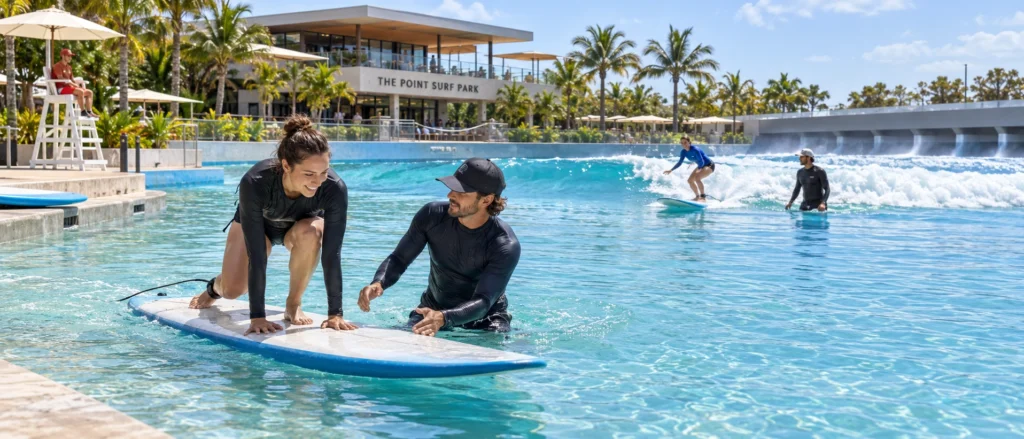
Learning to surf can feel intimidating when the ocean is constantly changing around you. One wave arrives quickly. The next barely breaks. Wind changes the surface, currents move you out of position, and other surfers may already seem completely comfortable in the water. A Wave Pool offers beginners a different starting point. At The Point Surf Park in Fellsmere, Florida, our beginner experience is built around controlled waves, guided instruction, and progressive session levels. Instead of asking first-time surfers to understand every part of the ocean at once, we can help them focus on the basic movements that make surfing work. For people looking into caroline marks surfer programs or beginner surfing in Florida, the main advantage is simple: repeatable waves can give new surfers more chances to practice the same skills in a structured environment.
Can You Learn to Surf in a Wave Pool?
Yes, beginners can learn to surf in a wave pool, and a controlled environment can make the early stages of learning easier to understand. Instead of relying on natural ocean waves that change in size, shape, speed, and timing, a surf wave pool can produce more predictable conditions for beginner sessions. At The Point Surf Park, first-time surfers can begin through the Caroline Marks Surf Academy, which includes land-based instruction and in-water coaching before progressing into controlled waves. Beginners can practice body position, paddling, standing up, balance, timing, and basic board control while instructors provide guidance. The Point also separates surf experiences by skill level, from Surf Academy and Beginner sessions through Intermediate, Advanced, Expert, and Pro levels. This allows new surfers to progress instead of immediately entering waves designed for experienced riders. A wave pool does not remove every risk associated with surfing, but it can reduce some of the unpredictability that comes with learning in the ocean and provide a more repeatable environment for building confidence.
Why Can a Wave Pool Be Helpful for Beginner Surfers?
Repetition is one of the biggest advantages. In the ocean, a beginner may wait several minutes for a suitable wave, then discover that it breaks differently from the previous one. That can make it difficult to know whether a mistake came from body position, timing, paddling, or simply a changing wave. A controlled Wave Pool makes the wave itself more predictable. When the beginner knows roughly what is coming, it becomes easier to focus on one skill at a time. You can work on where your body sits on the board, when to begin standing, how wide your stance should be, and what happens when your weight shifts too far forward or backward. That does not mean surfing suddenly becomes easy. It means there are fewer variables competing for your attention during the first stages of learning.
What Happens Before You Enter the Water?
A beginner session usually starts before anyone catches a wave. At The Point, first-time surfers can start with the Caroline Marks Surf Academy, which is described as a guided introduction combining land-based instruction with in-water coaching. On land, beginners can learn basic board positioning, paddling movements, how to stand up, balance, stance, and basic safety procedures. This preparation matters because the movements can feel unfamiliar at first. Practicing them while the board is stable gives you time to understand what your body is supposed to do before adding moving water. The Point also recommends arriving early enough for check-in, gear preparation, and a pre-session briefing. People searching for Caroline Marks surf beginner instruction may be most interested in riding the first wave, but the preparation before that ride is what helps make the water portion easier to understand.
What Equipment Do Beginners Use?
Beginners do not need to arrive with expensive surf equipment. The Point plans to offer rentals including soft-top boards, wetsuits, helmets, rashguards, life vests, and other equipment. Current visitor guidance states that only soft-top surfboards are permitted during Beginner sessions and that helmets are required for Beginner surf lessons and Beginner sessions. Soft-top boards are commonly used for learning because they provide a beginner-friendly platform for developing basic board control. The goal during your first sessions is not to use advanced equipment. It is to become comfortable with positioning, paddling, timing, standing, and balancing. Equipment can become more specialized as your skills improve.
What Skills Do You Practice First?
Most beginners focus on several fundamentals. The first is body positioning. If you lie too far forward, the nose of the board may dip. Too far back, and the board may not move efficiently through the water. Paddling comes next because you need enough forward movement to connect with the wave. Then comes the transition from lying down to standing. This movement is often called the pop-up. Once you are standing, you begin learning stance, balance, and where to look. Beginners also learn how to fall, recover, and stay aware of the board and other surfers. These skills are simple to describe but take repetition to develop. That is why consistent waves can be so useful.
Will You Stand Up During Your First Session?
You might, but there is no guarantee. Some beginners stand during their first few attempts. Others need more practice before the movement feels natural. Neither result means someone is better suited to surfing. Balance, flexibility, confidence, timing, strength, and comfort in the water all develop differently from person to person. The Point describes its Surf Academy as a program designed to help first-time surfers safely learn the fundamentals and ride their first waves. The better goal is to leave the session understanding more than you did when you arrived. A short ride can be a big achievement when you are learning.
Is Learning in a Wave Pool Easier Than Learning in the Ocean?
It can be easier to understand, but the experiences are different. The ocean requires beginners to deal with changing wave conditions, wind, currents, tides, paddling position, and other natural variables. NOAA notes that natural surf zones can also contain hazards such as rip currents, and it recommends checking beach conditions, knowing how to swim, following lifeguard instructions, and using lifeguard-protected beaches when possible. A controlled surf environment removes some of those ocean-specific variables. At The Point, sessions are organized by ability, and the park describes its approach around controlled waves and safe progression. That can help beginners focus on surfing mechanics first. However, learning in a wave pool does not automatically teach every ocean skill. Reading natural waves, understanding currents, navigating a lineup, and recognizing changing conditions still need to be learned separately if you later move into ocean surfing.
Can Wave Pool Skills Transfer to Ocean Surfing?
Many basic skills can. Paddling, body position, standing up, stance, balance, board control, and looking where you want to go are all useful in both environments. The difference is that the ocean adds another layer of decision-making. You need to identify which waves are suitable, position yourself correctly, understand changing conditions, and respect other surfers. A wave pool can therefore be a useful place to build the physical basics before adding more ocean variables. Think of it as one stage of learning rather than a replacement for every type of surfing.
How Do You Know When You Are Ready for a Harder Wave?
Progress should be based on control, not excitement alone. At The Point, surf experiences progress through Surf Academy, Beginner, Intermediate, Advanced, Expert, and Pro levels. A beginner should become comfortable catching waves, standing consistently, controlling the board, and following session rules before moving up. Intermediate waves may require more independent positioning and better control. Advanced settings demand even more speed, balance, and decision-making. There is no benefit in moving up before you can handle the current level safely. The goal is steady progression.
What Should You Bring for a Beginner Wave Pool Session?
The Point recommends bringing a swimsuit, towel, sunscreen, change of clothes, water bottle, required medication, and identification when needed. Rental equipment may be available, so beginners do not necessarily need to own a surfboard or wetsuit. It is also useful to arrive with realistic expectations. You may fall many times. You may feel tired sooner than expected. Your arms may discover that paddling is harder than it looks. Those are all normal parts of learning. Bring curiosity rather than pressure to perform.
Can Kids Learn to Surf in a Wave Pool?
The Point describes its Surf Academy as suitable for total first-timers, kids, and nervous beginners. A structured environment can be especially useful for younger participants because sessions can match ability levels and instructors can introduce skills gradually. Parents should still review current age, waiver, swimming, supervision, equipment, and session requirements before booking. The Point’s Plan Your Visit page is the best place to check current participation rules.
Why Learn at The Point Surf Park?
At The Point Surf Park, we are building the beginner experience around safe progression, mentorship, physical well-being, and community. The Caroline Marks Surf Academy gives total first-timers a guided place to begin, while our progressive session levels create a path for surfers who want to keep developing. The park also plans to provide rentals, showers, lockers, spectator areas, food, wellness amenities, and other features that make the experience easier for families and groups. People searching for Caroline Marks surf opportunities may first notice the academy name, but the bigger value for a beginner is the structure around the session. You do not need to arrive knowing how to surf. You arrive ready to learn, and the experience is designed to help you build from there.
Frequently Asked Questions
Is a Wave Pool Good for Someone Who Has Never Surfed?
Yes. A controlled wave environment can be especially useful for first-time surfers because the waves are more predictable and sessions can be organized around beginner ability. The Point’s Surf Academy is specifically designed for first-timers.
Do I Need to Be a Strong Swimmer?
You should be comfortable in the water and meet the facility’s current participation requirements. If you are unsure about your swimming ability or a child’s readiness, check with the park before booking.
How Many Waves Will I Catch in My First Session?
There is no fixed number. Session structure, group size, skill level, wave settings, and how quickly you recover between attempts can all affect how many waves you ride.
Do Beginners Have to Wear Helmets?
Yes. Current The Point visitor guidance requires helmets for Beginner surf lessons and Beginner sessions.
Final Thoughts
You can absolutely learn basic surfing skills in a Wave Pool. For a beginner, the biggest advantage is consistency. When the waves are controlled, you can spend more time focusing on paddling, standing, balance, timing, and board control instead of trying to understand a constantly changing ocean at the same time. You will still fall. You will still need practice. And if you eventually want to surf in the ocean, you will still need to learn natural surf conditions and water safety. But a structured wave-pool environment can give you a clear place to begin and a progression path once the basics start to feel natural.
Start With a Wave Built for Learning
If you have always wanted to surf but were unsure about starting in the ocean, explore the Caroline Marks Surf Academy at The Point Surf Park. You can also review the Plan Your Visit guide for beginner equipment, check-in details, spectator information, and current session requirements before planning your first experience.