
How long does it take to learn to surf? It depends on what you mean by “learn.” Many beginners stand up and ride whitewater in their first few sessions. Catching unbroken waves takes longer, and angling across the face, turning with control, and building speed take longer still.
Someone who surfs twice a week in consistent conditions progresses very differently from someone who surfs once every few months. So instead of one number, think in stages. The goal isn’t to race through them; it’s to get consistent enough at each one that the next step feels manageable.
At The Point Surf Park, we built our levels around this same step-by-step progression, from the Surf Academy to Pro.
What Does “Learning to Surf” Actually Mean?
Learning to surf has no single finish line. Standing up once is very different from catching your own wave, choosing a direction, turning and controlling your speed.
For a first-timer, success might be getting to your feet and riding toward shore. A few sessions later, it’s staying balanced without looking down at the board. Then the goal shifts again: paddling into an unbroken wave, timing your takeoff, angling down the line, staying on the open face and, eventually, making deliberate turns.
The early stages can come quickly. The later ones depend on repetition.
Stage 1: Your First Sessions
The first stage is about getting comfortable on the board, finding a stable stance and making the pop-up feel less complicated. For many people, it takes roughly 1 to 3 sessions. You won’t master the pop-up in that time, but the basic movements start to make sense.
You’re learning where your feet land, how to keep your eyes up, how to balance once you stand, and how your body position moves the board. Most of your attention is still on your own body: your hands, feet, knees, and whether you’re about to fall. That’s normal.
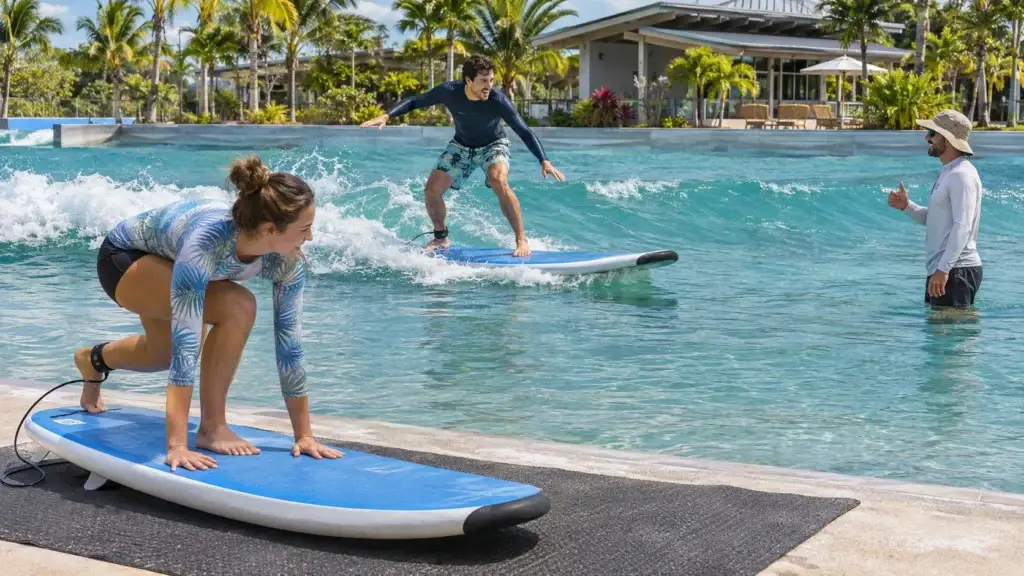
In the Caroline Marks Surf Academy, first-timers start with about 45 minutes of groundwork, then roughly 55 minutes of coached water time. That gives you time to understand each movement before repeating it in the water, and it’s worth knowing what happens during your first surf lesson before you book.
Stage 2: Riding Whitewater With Control
Next comes riding broken waves without feeling like every successful stand-up was luck. For many learners, this takes around 3 to 8 sessions, though the range is wide.
You’ll notice more consistency. Your pop-up gets smoother, your feet land closer to the right spot, and you stay upright long enough to make small adjustments. You also start to feel how much weight belongs on your front foot versus your back foot.
This stage is less exciting than your first green wave, but it matters. If your stance is unstable, everything later gets harder. Use whitewater to repeat the fundamentals until you stop thinking through every step. Helmets are required in all our Beginner lessons and sessions, so safety stays part of your progression while you build control.
Stage 3: Catching Unbroken (Green) Waves
Catching your own unbroken wave is one of the biggest jumps in surfing. For many learners, it happens somewhere around 5 to 15 sessions or more, depending on how often they surf and how consistent the conditions are.
This stage asks far more than standing up. You need to know where to sit, judge when the wave will reach you, paddle hard enough to match its speed and stand at the right moment. In the ocean, all of that keeps changing: one wave comes in faster than the last, the peak shifts, the tide moves you, and wind reshapes the face. The timing is part of the skill, which is why this stage takes longer than the pop-up.
Once you make these waves consistently, surfing feels different. You’re no longer just reacting after the wave pushes you. You’re entering the wave yourself.
Stage 4: Angling and Your First Turns
Once you can catch an unbroken wave, the next goal is to travel across it instead of straight to shore. For many surfers, this begins after roughly 8 to 20 sessions or more. Some get there sooner; others take longer because their sessions are spread out or conditions vary.
Angling starts at the takeoff, when you set yourself up to go left or right. Then comes trimming: adjusting your line to stay in the part of the wave that gives you speed. Small turns follow. They won’t look dramatic at first, and that’s fine. The aim is simply to control where the board goes. This is where surfing becomes less about survival and more about decisions.
Stage 5: Linking Turns and Building Speed
Once you can travel across the face reliably, progress gets more technical. This stage can take 20, 30, 50 sessions or many more, depending on your goals.
Now you’re working on bottom turns, top turns, cutbacks, speed generation, compression, extension, timing, and reading sections. There’s no point where you suddenly finish; experienced surfers keep refining these skills for years. The difference is that the fundamentals become automatic. Your attention moves from standing up to what the wave is doing next, and you start adjusting before you reach a section instead of after.
Surf Progression Timeline at a Glance
These ranges are rough guides, not promises or requirements.
| Stage | Main Skills | Rough Number of Sessions |
| First sessions | Pop-up, stance, balance, riding straight | 1 to 3 |
| Whitewater control | Consistent takeoffs, stable rides, small adjustments | 3 to 8 |
| Green waves | Catching unbroken waves, timing, positioning | 5 to 15+ |
| Angling and first turns | Riding left or right, trimming, directional control | 8 to 20+ |
| Linked turns and speed | Bottom turns, top turns, speed generation, wave reading | 20 to 50+, ongoing |
The ranges overlap because nobody progresses in perfectly separate steps. You may catch your first green wave before your whitewater takeoffs are fully consistent, or land one good turn long before you can repeat it. Judge your progress by what you can do consistently, not by the best wave you’ve ever ridden.
What Speeds Up or Slows Down Progress?
Five factors make the biggest difference to how fast you move through these stages.
Session Frequency
Surfing relies on timing and movement patterns that fade quickly. Surf twice a week, and you repeat each skill while it’s still fresh. Wait two months between sessions, and you’ll spend part of every surf relearning the basics. You don’t need to surf every day; regular repetition is what helps.
Fitness
You don’t need elite fitness, but basic swimming ability, paddle endurance, mobility and balance all help. Every participant in our sessions must be able to swim and perform reasonable self-rescue. Fatigue slows learning too: when you’re tired, your pop-up gets slower, your stance gets shakier, and your decisions suffer.
Board Choice
A beginner-friendly board makes progress easier. More length, width and volume help you paddle, catch waves and stand up consistently. A board that’s too small may look more advanced while actually cutting the number of useful waves you ride.
Coaching
Good coaching gives you specific feedback. You might know something feels wrong without knowing why, and a trained instructor can tell whether it’s your paddle timing, stance, foot placement or body position. The International Surfing Association, recognized by the International Olympic Committee as the world governing authority for surfing, runs a coaching and instructing program that sets the standard for instructor training, safety and skill progression.
Wave Consistency
Consistent waves remove many of the variables that slow learning in the ocean. When every wave is different, you’re constantly adapting. When waves repeat, you get a clear feedback loop: try something, notice what happened, change one thing and try again.
Do Wave Pools Help You Learn Faster?
They can make progress more efficient because conditions repeat. That doesn’t make surfing easy; you still need balance, timing, paddling, positioning, and board control. What changes is the uncertainty.
In the ocean, a beginner may wait a long time for the right wave, then find it breaks differently from the last one. In a controlled setting, the pattern is predictable, so you can repeat one skill. Working on your pop-up? You get the same basic takeoff again and again. Learning to angle left? You can ride that line again on the next suitable wave. That’s why learning to surf in a wave pool suits Floridians who don’t want to depend on the day’s ocean conditions.
The ocean still teaches what a pool can’t fully replace: changing swell, currents, shifting peaks, tides, wind and lineup judgment. The two work best together.
Frequently Asked Questions
Can Adults Learn to Surf?
Yes. Adults can learn at almost any age, as long as they meet the participation requirements and can swim and take part safely. Progress looks different for everyone, and there’s no rule that surfing has to start in childhood. Be patient, ride the right board, and focus on steady repetition rather than comparing yourself with younger surfers.
How Old Do Kids Need to Be?
We use a general minimum height of 42 inches rather than one minimum age for everyone. Some lessons and programs have extra age, height, supervision, or eligibility requirements, so check the details for your exact session before booking.
Do I Need to Be a Strong Swimmer?
You need to be able to swim and perform reasonable self-rescue. You don’t need to be a competitive swimmer, but you do need the confidence and ability to look after yourself after a fall. If you’re unsure, ask us before you book.
How Many Lessons Do Most Beginners Need?
There’s no fixed number. Some beginners stand up and ride whitewater in their first lesson, while others need several sessions to feel comfortable. As a rough guide, the first 1 to 3 sessions focus on standing and balance, consistent whitewater riding takes a few more, and unbroken waves take longer. Measure progress by what you can repeat safely and confidently, not by lesson count.
Final Thoughts
So, how long does it take to learn to surf? You can start learning in one session, and you may stand up in your first lesson. Riding whitewater consistently takes several sessions, catching green waves takes more, and turning, building speed, and reading waves well take many more.
That isn’t slow progress. Surfing has layers, and each stage builds on the one before. Rather than rushing through the levels, make each skill repeatable enough to build on. How fast you learn depends less on the calendar and more on how often you get quality practice. You can also see what other surfers say about us on Google.
Start Your Progression at the Surf Academy
If you’ve never surfed, the Caroline Marks Surf Academy gives you a structured start. Each lesson pairs about 45 minutes of groundwork with roughly 55 minutes of coach-guided water time, so you learn the fundamentals before moving into Beginner sessions.
Participants need to meet the session requirements, including the general 42-inch minimum height and the ability to swim. Have questions before you book? Plan your visit, and we’ll help you take your first pop-up toward the next stage, one session at a time.