
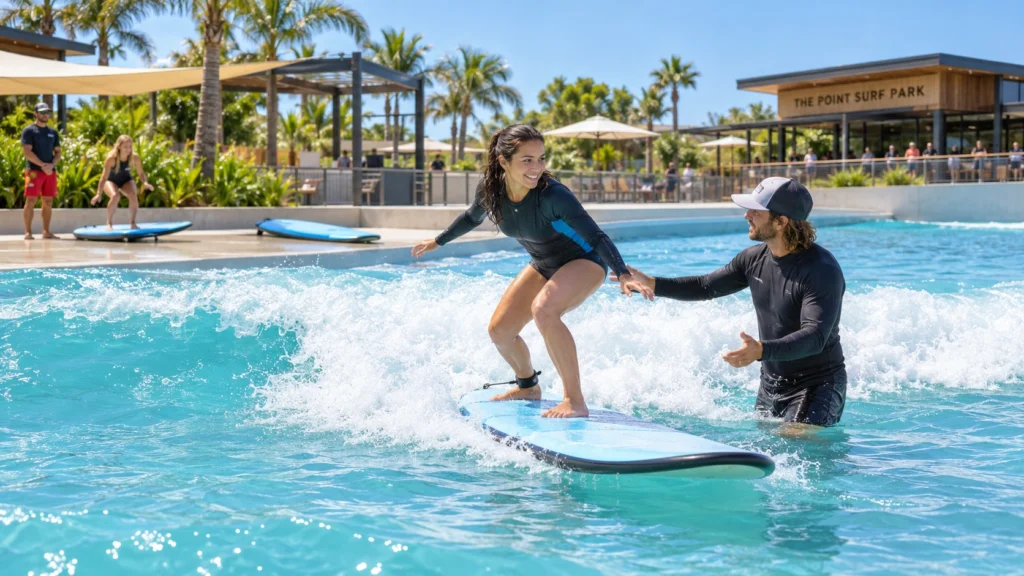
Your first Surf Lesson can feel exciting and intimidating at the same time. You may be wondering whether you are fit enough, whether you will actually stand up, what happens when you fall, or whether everyone else will already know what they are doing. At The Point Surf Park, beginners are exactly who our introductory surf experience is designed for. The Caroline Marks Surf Academy is built around first-time surfers, including kids and people who may feel nervous about getting on a board for the first time. The program combines land-based instruction with in-water coaching before surfers begin practicing on controlled waves. For people researching Caroline Marks surfing and beginner lessons in Florida, knowing what happens before you arrive can take away a lot of the uncertainty.
What Happens During Your First Surf Lesson?
During your first surf lesson, you normally start on land before entering the water. Your instructor introduces the surfboard, explains basic safety rules, shows you how to position your body, and teaches the movements used to paddle and stand up. At The Point Surf Park, the Caroline Marks Surf Academy is specifically designed as a fully guided introduction for first-time surfers, with land-based instruction followed by in-water coaching. Before entering the surf area, beginners also complete check-in, prepare their equipment, and attend a safety briefing. Soft-top surfboards are used for beginner sessions, and helmets are required for beginner lessons and sessions under The Point’s current visitor guidelines. Once you are in the water, the goal is not to perform advanced maneuvers. You begin with basic positioning, balance, timing, and riding controlled waves with support from an instructor. Falling is expected and is part of learning. The lesson is designed to help you understand the fundamentals, build confidence, and experience what it feels like to ride your first waves in a structured environment.
What Should You Expect When You Arrive for a Surf Lesson?
The experience begins before you enter the water. The Point recommends arriving early enough to complete check-in, confirm any required documents, collect rental equipment, change, and attend the pre-session safety briefing. Your booking confirmation should provide the recommended arrival time. You should bring a swimsuit, towel, sunscreen, change of clothes, water bottle, and any required personal medication. You do not need to own a surfboard. The Point plans to provide rental equipment, including soft-top surfboards, wetsuits, helmets, rashguards, life vests, and other surf gear, subject to availability. Arriving with enough time to get comfortable can make your beginner surf lesson feel much less rushed.
What Do You Learn on Land Before Surfing?
A good first lesson does not simply send you into the water and tell you to paddle. Land instruction gives you time to understand the movements before waves are involved.
Your instructor may introduce:
- Basic parts of the surfboard
- How to lie on the board
- Proper body position
- Basic paddling technique
- How to move from lying down to standing
- Foot placement
- Balance and stance
- How to fall more safely
- Basic surf-area awareness
The standing movement is often called a pop-up. Do not worry if it feels awkward the first few times. Learning the movement on a stable surface allows you to practice without also thinking about moving water. For people looking up Caroline Marks surfing because they want to learn through the Caroline Marks Surf Academy, this guided foundation is an important part of The Point’s beginner experience.
What Kind of Surfboard Will a Beginner Use?
Beginners generally start on a soft-top surfboard. The Point’s current rules require soft-top surfboards for all beginner sessions. Rental soft tops are planned to be available on site. Soft-top boards are commonly used for learning because their design is beginner-friendly and suitable for introductory sessions. The board selected for you may depend on your size, ability, and the lesson setup. You do not need to worry about choosing a high-performance surfboard for your first day. Your priority is learning how to position yourself, paddle, stand, balance, and follow instructions. More advanced boards can come later.
Do Beginners Have to Wear a Helmet?
At The Point, yes. Current visitor guidance states that helmets are required for all Beginner surf lessons and Beginner sessions. Other equipment requirements can vary according to the session, participant, and operating rules. The instructor will explain what you need before entering the water. Beginners should also follow all staff instructions, stay within their assigned surf area, and use only equipment approved for the lesson. Those rules are there to create a more structured environment while everyone is still developing basic board control.
What Happens When You Enter the Water?
Once the land instruction is complete, the lesson moves into the water. This is where the movements you practiced begin to make sense. Your instructor may help you position the board, prepare for the approaching wave, and understand when to paddle or begin standing. The Point uses controlled waves, which creates a different learning environment from a natural beach. Because the wave experience is more predictable, beginners can focus on repeating the same basic skills rather than adjusting to completely different ocean conditions every few minutes. Your first attempts may involve staying low, finding balance, and getting comfortable with the board. You may stand for only a second. That still counts as progress.
Will You Actually Stand Up During Your First Surf Lesson?
Many beginners hope to stand on their first day, and The Point’s Surf Academy is designed to help first-time surfers work toward riding their first waves. However, there is no rule saying you must stand perfectly during your first lesson. Some people understand the pop-up quickly. Others need more time to develop balance, timing, confidence, or paddling technique. What matters is that you learn the basic process correctly. Your first successful ride may be only a few seconds long. For a new surfer, those few seconds can be the moment everything starts to click. The goal should be progress rather than comparing yourself with another beginner.
What Happens When You Fall Off the Surfboard?
You will probably fall. That is completely normal in surfing. Beginners often fall because their feet are too close together, their weight is too far forward or backward, they stand too slowly, or they simply lose balance. The instructor will explain how to respond when you fall and how to regain control of yourself and the board. Stay aware of instructions and other participants in the surf area. Falling is part of learning how your body and the board respond to moving water. The more attempts you make, the easier it becomes to recognize what needs to change on the next wave.
Is Learning in a Surf Park Different From Learning in the Ocean?
Yes. Both environments teach surfing, but the conditions are different. Ocean surfing involves natural waves, currents, changing wind, tides, and other surfers. The National Oceanic and Atmospheric Administration warns that natural surf zones can contain hazards such as rip currents and recommends checking beach conditions and using lifeguard-protected areas whenever possible. A controlled surf park removes some of those natural variables. At The Point, beginners learn in a managed environment with controlled waves, guided sessions, lifeguards, required beginner equipment, and skill-based progression. That does not mean surfing becomes risk-free. Boards, falls, moving water, and other participants still require attention and respect. The difference is that the learning environment is more predictable.
Do You Need to Be a Strong Swimmer to Take a Surf Lesson?
You should be comfortable in the water and meet the lesson’s current participation requirements. Surfing is a water activity, so basic swimming ability and confidence around water are important. If you have questions about swimming requirements, age limits, medical considerations, or whether the lesson fits you or your child, confirm the current requirements with The Point before booking. NOAA’s ocean-safety guidance emphasizes knowing how to swim before entering natural surf and following lifeguard instructions. Those ocean guidelines are also useful reminders that water confidence and respect for safety matter wherever you learn.
What Should You Do After Your First Lesson?
After the session, give yourself time to think about what felt comfortable and what felt difficult. Maybe your paddling worked well, but standing felt rushed. Maybe you stood quickly but had trouble maintaining balance. Those observations can give you something specific to work on next time. The Point offers a progression beyond the introductory Surf Academy, including Beginner, Intermediate, Advanced, Expert, and Pro levels. You should move forward based on skill and confidence rather than trying to rush into a harder session. You can also use The Point’s Plan Your Visit guide to review equipment, rentals, arrival information, spectator access, and other details before returning.
Why Learn to Surf at The Point Surf Park?
At The Point Surf Park, our beginner experience is built around safe progression, mentorship, physical well-being, and community. We want first-time surfers to feel like they belong in the water, even if they have never touched a surfboard before. The Caroline Marks Surf Academy provides guided instruction before and during the water portion of the experience. After that, surfers can progress through increasingly challenging session levels as their skills develop. For families, The Point also plans spectator areas, food, rentals, showers, lockers, wellness amenities, and other features that make it possible to spend more than just a lesson at the park. People searching for caroline marks surfing may initially be interested in the connection to the academy, but the larger goal is straightforward: give beginners a supportive place to understand surfing, build confidence, and experience the feeling of riding a wave.
Frequently Asked Questions
What Should I Wear to My First Surf Lesson?
Bring a swimsuit that stays secure while you move in the water. Depending on water temperature and session conditions, a wetsuit or rashguard may also be appropriate. The Point plans to offer rental wetsuits, rashguards, helmets, and other equipment.
Do I Need to Buy a Surfboard Before My Lesson?
No. Beginners can use rental equipment, and The Point plans to provide soft-top surfboards for learning. Current rules require soft-top boards during Beginner sessions.
How Early Should I Arrive for a Surf Lesson?
Arrive early enough for check-in, equipment preparation, changing, and your safety briefing. The exact recommended arrival time should appear in your booking confirmation.
Can I Take Another Beginner Session After the Surf Academy?
Yes, depending on current booking availability and the level recommended for you. The Point offers progressive session levels so surfers can continue practicing before moving into more challenging waves.
Final Thoughts
Your first Surf Lesson is not about becoming an expert in one day. It is about understanding the board, learning basic body position, practicing your pop-up, becoming comfortable in the water, and experiencing your first real attempts at riding a wave. You will probably fall. You may feel awkward. You may also stand up for a few seconds and immediately understand why people become obsessed with surfing. A structured beginner environment can make those first attempts feel much more manageable. At The Point, controlled waves, coaching, beginner equipment, lifeguards, and skill-based progression are designed to give new surfers a clear starting point. The first lesson gives you the fundamentals. What you do with them afterward is where your own surfing journey begins.
Make Your First Wave the Start of Something New
If you have been thinking about trying surfing but have never known where to begin, explore the Caroline Marks Surf Academy at The Point Surf Park. You can also review our Plan Your Visit information before your session so you know what to bring, when to arrive, and what equipment is available.
Pingback: How Long Does It Take to Learn to Surf? | The Point