
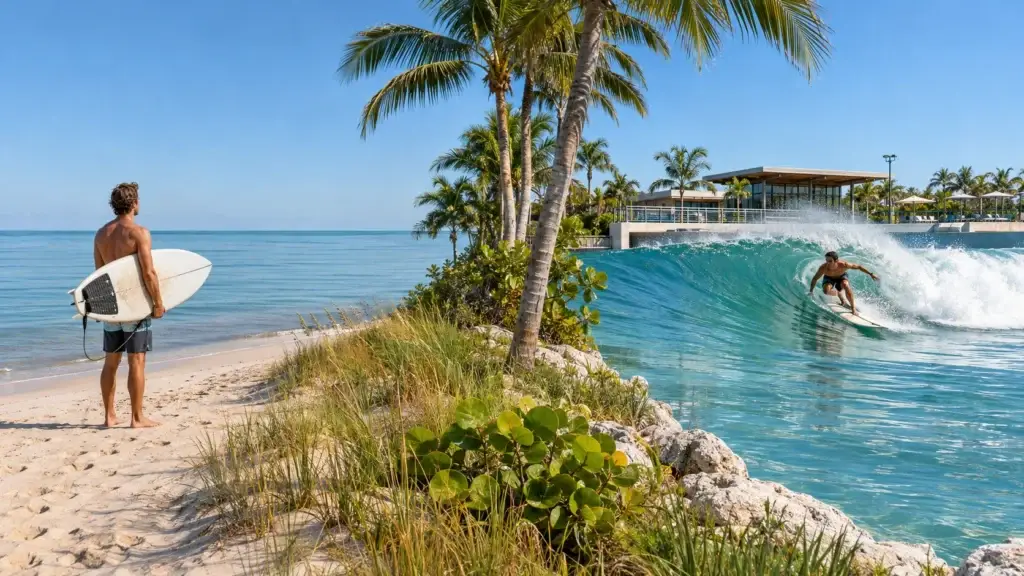
Yes. You can keep improving when the ocean is flat by working on pop-ups, mobility, balance, and paddle fitness on land, then using wave pool sessions to keep your wave timing sharp.
For Florida surfers, flat spells break momentum. Your turns are getting cleaner, and your paddle fitness is up, then the ocean gives you almost nothing for days or weeks. That doesn’t have to stop your progress. The goal is to hold on to the movement and fitness you’ve built while finding other ways to get quality reps, so you come back to the ocean ready instead of rusty.
At The Point Surf Park, we built our park so Florida surfers can ride and train year-round, even when the forecast goes quiet.
Why Do Florida Surfers Deal With So Many Flat Days?
Florida surf depends on changing swell, weather, wind, and storm patterns, so having time to paddle out doesn’t guarantee waves. Some stretches deliver plenty of chances. Others leave you checking the forecast every morning with nothing worth riding.
It’s a well-known problem here. When Sebastian Daily covered our park’s construction, it described Florida as a state known for flat ocean conditions, which is why consistent waves matter so much to local surfers.
Flat spells hurt most when you’re working on a specific skill. Improving a cutback, bottom turn, or speed generation takes enough similar waves to repeat the move, and waiting weeks between good sessions makes that hard.
Can You Keep Improving Without Ocean Waves?
Yes, though not every part of surfing can be trained away from the water. You can’t fully recreate wave reading, takeoff timing, changing sections, or the feel of moving water on dry land.
What you can keep is the physical base behind those skills: pop-up speed, leg strength, balance, shoulder endurance, hip mobility, and general conditioning. A flat spell is also a good time to spot your weak areas. Maybe your legs tire halfway through a session, your shoulders fade on repeated paddles, or you can’t compress deep enough through turns. Now you can work on those without trying to fix them mid-wave.
What Land Drills Carry Over to Surfing?
The best land drills are simple movements tied to something you actually do in the water. You don’t need to turn every flat week into a training camp; a few focused sessions keep the key movements familiar.
Practice Your Pop-Up
Pop-ups are worth practicing even past the beginner stage, because a slow or uneven pop-up puts you behind on a fast wave before your first turn.
Start from the position you lie in on your board and move into your surf stance smoothly, without looking at your feet. Land with your feet where you want them, knees ready to move, chest controlled and eyes forward. A handful of clean reps beats dozens of sloppy ones.
Use Balance and Surf-Skate Training Carefully
Balance training builds body awareness, but it should support your surfing, not become a trick of its own. Surf-skating is useful for practicing compression, extension, rotation and the rhythm of carving, and for noticing where your eyes, shoulders, hips and legs go through a turn.
The limit is obvious: pavement isn’t a wave. A surf skate won’t teach you to paddle into a wave, read a section or react to moving water. Use it to groove the movement, then take that movement back to your board.
Work on Mobility for Turns
Tight joints make good technique harder. Hip mobility matters when you compress into a turn, ankle mobility affects how well you bend and load your legs, and upper-back rotation lets your upper body move with the board instead of against it.
Simple, controlled mobility work beats forcing deep stretches. Focus on range you can actually use. If you’re often stiff after surfing, build recovery into your flat weeks instead of rediscovering the same tightness on the next good swell.
How Do You Keep Your Paddle Fitness Up?
Paddle fitness fades fast. You can feel fit overall, then paddle out after a long break and find your shoulders burning far sooner than expected.
Swimming builds upper-body endurance and keeps you comfortable in the water. If you have safe access to calm water, paddling your own board is even more specific. On land, focus on pulling movements, shoulder stability, core work and aerobic conditioning. You don’t need hundreds of band reps copying the paddle stroke; the goal is keeping your shoulders, back, core and lungs ready for repeated effort.
Don’t skip recovery. If you train hard every flat day and show up to the next swell with tired shoulders, the extra work has missed the point.
How Does a Wave Pool Fill the Gap?
A wave pool gives you what land training can’t: real waves. When the Atlantic is flat, a controlled session lets you keep working on takeoffs, turns, speed, timing and board control without waiting for swell.
Our sessions run from Beginner through Intermediate, Advanced, Expert and Pro, so an experienced ocean surfer never has to book a first-timer session. A surfer working on linked turns needs a very different wave from someone still learning the open face. Compare our surf levels and book around what you can already do, not because it’s your first visit to a pool.
Flat Ocean Doesn’t Mean a Flat Session
Our wave doesn’t depend on the ocean producing swell, so you can keep a regular surfing rhythm through a flat stretch. It’s also repeatable: if you’re working on your bottom turn, you can make one change from one wave to the next instead of hoping the ocean sends another similar section.
Sessions still depend on operating conditions. We may pause or close surfing for weather, lightning, mechanical issues, maintenance or safety concerns, and when that happens we may offer a credit, voucher or rebooking under our current policy. The advantage isn’t that weather never affects a session. It’s that a missing ocean swell doesn’t decide whether your wave exists.
What Does a Simple Flat-Spell Training Week Look Like?
You don’t need to train every day. A simple week might look like this:
- Monday: mobility plus clean pop-up reps
- Tuesday: swimming or paddle-focused conditioning
- Wednesday: rest or light recovery
- Thursday: surf-skate session focused on one movement, such as compression and rotation
- Friday: short strength and mobility session
- Weekend: a wave pool session at your level, or the ocean if the swell returns
Adjust it around your fitness and your normal surf load. If you surf hard on Saturday, Sunday doesn’t need to be another intense day; recovery is part of staying consistent. Our Wellness Center offers stretching, sauna, and ice baths for recovering between sessions.
What Should You Work On Before the Next Swell?
Pick the weakness that limits your surfing most often:
- Fading late in sessions? Work on fitness.
- Pop-up breaking down on faster waves? Practice clean movement.
- Can’t get low enough through turns? Work on usable mobility.
- Technique good but inconsistent? Use controlled waves for repetition.
Don’t try to fix five things in one flat spell. One clear goal gives you something specific to test when the ocean turns back on. Say your goal is entering every bottom turn lower and looking at the section earlier. Practice the movement on land, repeat it in a controlled session, and by the next swell you’ll have far more reps behind you than if you’d just waited for the forecast to change.
Can Wave Pool Surfing Replace Ocean Surfing?
It doesn’t need to. The ocean teaches you to read changing peaks, currents, wind, swell direction, tides, crowds, and wave shape. A pool gives you repetition and predictability. There are real differences between surf park and ocean surfing, and those differences are why the two work so well together.
Use consistent waves to sharpen a turn, then take that improved movement back to conditions where you have to choose the wave and section yourself. For Florida surfers who rarely get a well-shaped practice wave every week, that combination is a big part of why Fellsmere is becoming a new surf destination on Florida’s east coast.
Frequently Asked Questions
Is Surf-Skating Good Training for Surfing?
Yes, for movement patterns like compression, extension, rotation, and carving, but it doesn’t replace real surfing. Treat it as one part of your training, not a substitute for wave timing or moving water, and keep each drill tied to something you want to improve on your board.
Will Wave Pool Surfing Make Me Rusty in the Ocean?
No, as long as you keep treating ocean surfing as its own skill. A pool keeps your takeoffs, turns, speed generation, balance, and board control sharp through a flat spell. You’ll still need to read currents, swell, shifting peaks, wind, and other surfers when you get back in the ocean; controlled waves add to those skills rather than replacing them.
How Often Should I Surf During a Flat Spell?
There’s no set number. Pick a rhythm that keeps your surfing going without hurting your recovery or your schedule. For some surfers, one controlled session in a flat week is enough to keep timing sharp; others surf more when they’re actively training. Quality and consistency matter more than a session count.
Do I Have to Start at Beginner if I Already Surf the Ocean?
No. Book the level that matches what you can already do. If you catch unbroken waves and angle down the line, Intermediate or above is likely a better fit than Beginner. If you’re between two levels, start with the lower one and move up once you’ve shown you’re comfortable.
Final Thoughts
A flat ocean doesn’t have to mean sitting still until the next swell. Use the downtime on purpose: keep your paddle fitness alive, practice clean pop-ups, work on mobility, use surf-skating where it helps, and recover well.
Most of all, keep real wave time in your routine when progress matters to you. A Florida flat spell can take natural waves off the schedule, but it doesn’t have to undo the work you’ve put into your surfing. When the ocean turns back on, you want your timing, fitness, and movement still familiar. You can also see what other surfers say about us on Google.
Keep Surfing Through the Flat Spell
We give Florida surfers a way to keep riding consistent waves when the ocean forecast is quiet. Choose the session that matches your real ability, decide what you want to work on before you arrive, and use the repeatable waves to keep your progress moving.
Book your next session at your level so the next flat spell becomes training time instead of lost time. Questions before you come out? Plan your visit, and we’ll help you get set.